On the day when the weight deadens on your shoulders and you stumble, may the clay dance to balance you.
And when your eyes freeze behind the grey window and the ghost of loss gets into you, may a flock of colours, indigo, red, green and azure blue, come to awaken in you a meadow of delight.
When the canvas frays in the currach of thought and a stain of ocean blackens beneath you, may there come across the waters a path of yellow moonlight to bring you safely home.
May the nourishment of the earth be yours, may the clarity of light be yours, may the fluency of the ocean be yours, may the protection of the ancestors be yours.
And so may a slow wind work these words of love around you, an invisible cloak to mind your life.
This is such a great piece from Rebecca Solnit! There is indeed so much trauma, so much destruction and death, so much devastating and sadistic cruelty, so much that is just horrifying and heartbreaking. And it is all happening at the hands of those who've lost connection with the strength and wisdom of their hearts.
AND, that said, I am heartened by all of the courageous and fiercely loving human beings in our nation and across the Earth who are rising up individually and collectively to expose the brutality and criminality and to stand in protection of all that is endangered and being harmed so mercilessly. Deepest bow of respect, appreciation, and gratitude!!
My deep prayer for the New Year: May the harm stop. 🙏🙏 Molly
Petaluma Textile and Design use its picture windows to make magnificent displays, sometimes purely festive, sometimes intensely political. This was part of its fall display. Let it stand for all the ways that people have shown up to speak up across this country, against tyranny.
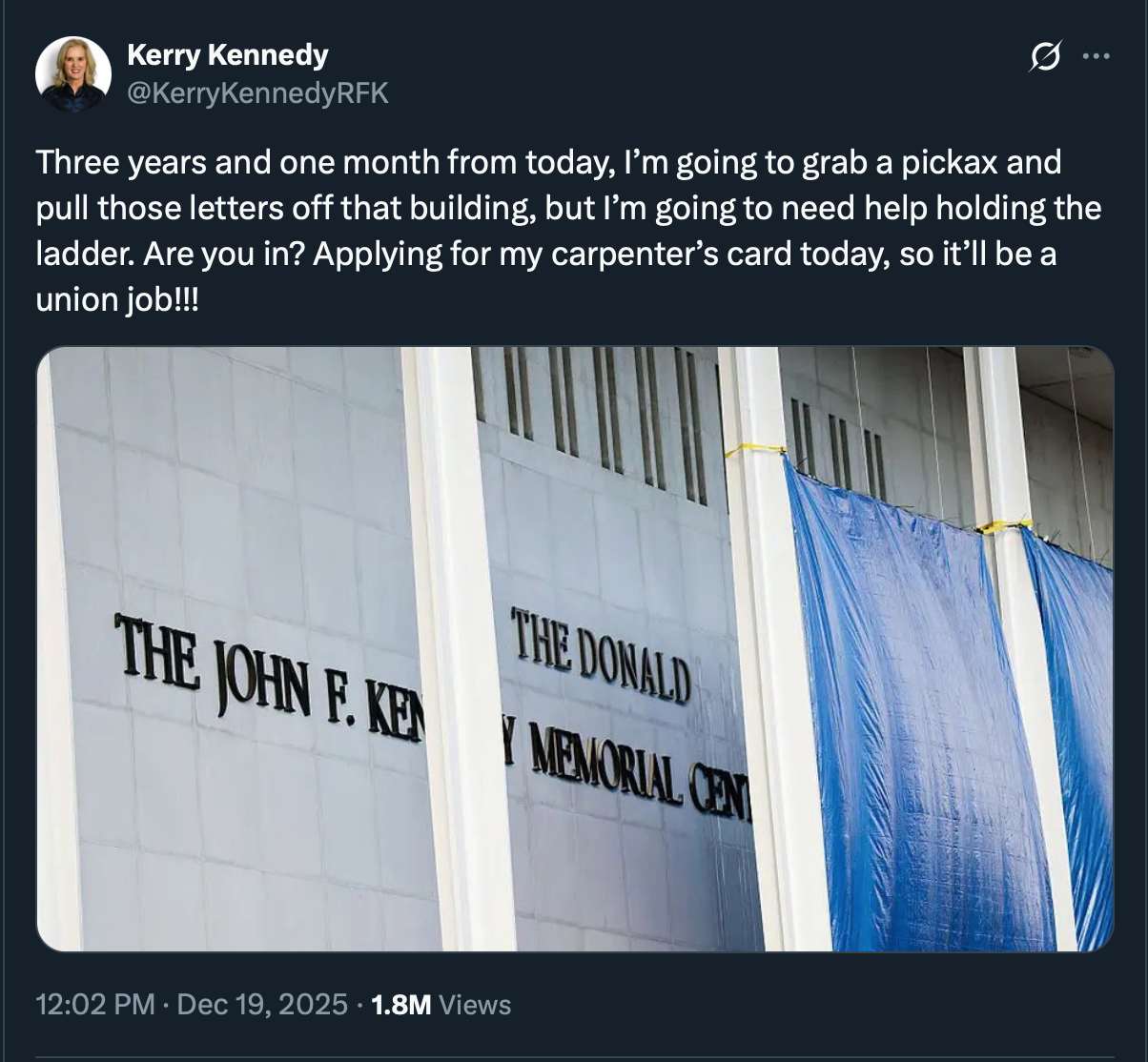
There's no show this New Year's Eve at the John F. Kennedy Center for the Performing Arts because the jazz musicians scheduled to play will be a no-show. They cancelled. A fun thing happened after Donald Trump first took over control of the John F. Kennedy Center for the Performing Arts and then put his name above that of our 35th president in whose honor the center was built and named. Trump perceived the center as in essence an object he could grab, and in some ways it was – and in other ways it wasn't. Trump now largely controls the building – but he doesn't own the arts or the artists or the audience.
"Empty seats, canceled shows plague Kennedy Center ahead of Trump renaming," says the headline of a recent article in the Washington Blade, and since he slapped his name on the building, the cancellations that have been going on for several months have intensified. Trump has taken over a building, corrupted its meaning and name and legacy, and found out nobody wants to play with him or for him. An arts center is not an object; it's a set of relationships between artists, audiences, and administration, and Trump broke those relationships, which were not for sale, and not in the hands of any one person and never can or will be. It's a microcosm of something that has happened a lot this year in more important ways.
I opened one of my first newsletters after launching Meditations in an Emergency February 2nd with these words: "I can sum up the Trump/Musk/Vance theory of power in five words: 'We have power; you don't.'" Except we do, and we have used it ferociously, creatively, devotedly, bravely this year. What has happened at the Kennedy Center is that artists have exercised their power to not cooperate. Governors and mayors and the state and city workers under them have likewise declined to cooperate in 2025. So have all sorts of people in all sorts of places and situations. As Patti Smith famously sang, "People Have the Power." Not always, not everywhere, but sometimes, when we take it.
Ordinary people have chosen to speak up in countless ways, holding up signs on freeway overpasses, making the #NoKings demonstrations the largest in this country's history, donating and supporting resistance groups, showing up in immigration court to try to prevent ICE from nabbing people, just like they have in cities and suburbs across the country, supporting their neighbors under attack in many small and personal ways that sometimes do but often don't get recorded. The resistance has been robust, and even remarkable. Indivisible membership grew immensely; new organizations sprang up, neighborhoods and communities created their own organizations and networks.
The same thing that happened to Trump happened to Elon Musk. He's the richest man in the world, in money anyway (in every other way he's deeply impoverished), and he has a lot of power that he bought with some of that money. He used that to harm and ordain the deaths of a lot of poor people with his attack on USAID (estimates are that 600,000 have already died and more than 13 million will as a result). Which was itself only part of sabotaging and corrupting crucial parts of the federal government while treating federal workers like dirt. But early this year the Tesla Takedown protests helped increase his unpopularity (he did a lot of that work himself). This resulted in plummeting Tesla sales, share prices, and public opinion, about which he could do nothing except whine. He too ran into the limits of his power, and he shuffled backward out of government in chagrin. Likewise, he sank a lot of money in backing a right-wing judge in the race for a seat on the Wisconsin Supreme Court, and Wisconsinites voted the progressive candidate to a resounding victory anyway.
And then there's Stephen Miller: as the indispensable Greg Sargent points out in the New Republic, "in important ways, Miller is falling short of his most elaborate authoritarian designs. The deportations are lagging far behind his hopes. He has not persuaded Trump to deploy the dictatorial power he pines to see. And he has unleashed a cultural moment in defense of immigrants that is more powerful than anything he anticipated. " Authoritarians and elites often assume that we are like them, selfish and cowardly. They assumed we would be cowed by their puissance – or at least threats and their masked thugs in the streets – and do nothing if we ourselves were not impacted, that there would be no serious impediments to their rampages, no obstacles put in their way, no solidarity across differences. There have been many.
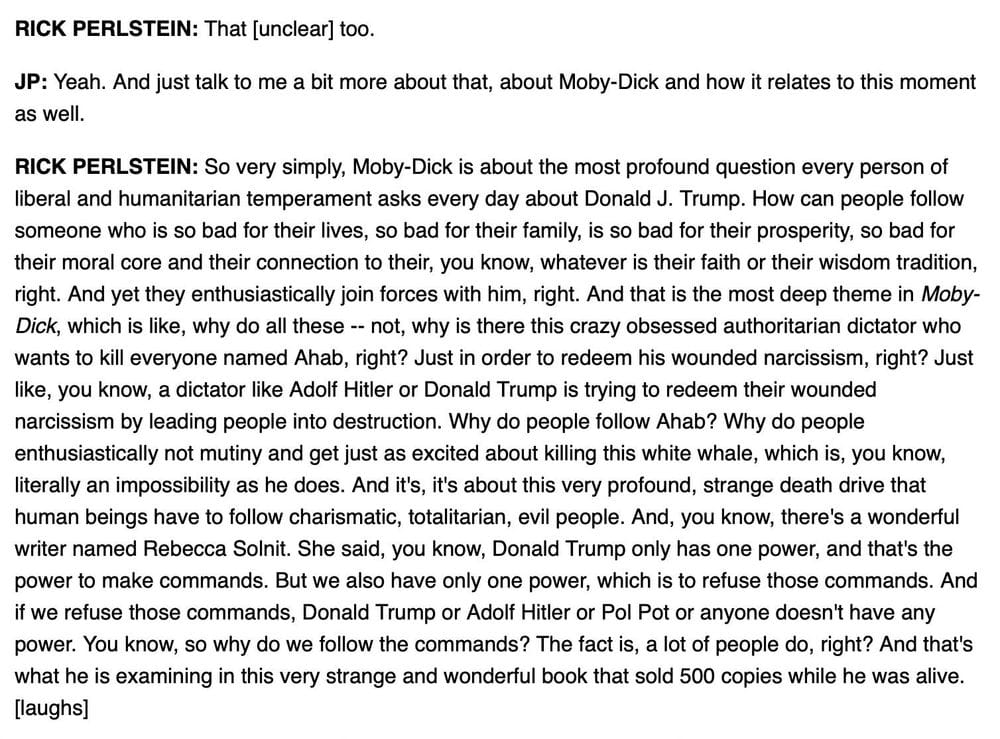
This fun comment in the screenshot below by historian Rick Perlstein is part of what prompted this last-minute essay (I know 2026 is just hours away, especially for those of you on the East Coast, and it's already here in Europe and well into Thursday beyond that, as my friend and collaborator Thelma, who lives in Fiji, reminded me). I don't think I said it quite that way, but I did say somewhere that they have the power to command. We have the power to refuse to obey the commands. Donald Trump is not singlehandedly doing all those things – he's giving orders and when people don't follow them the orders aren't worth the electrons with which he screeched about them on social media. We've seen an admiral resign rather than continue taking illegal orders to kill civilians in the Caribbean, and we know there is a lot we are not seeing as federal employees in quiet ways decline to cooperate with illegal, unjust, and destructive orders and policies. We've seen legislation passed to counter what they're doing – tomorrow, January 1, California's new law banning law enforcement from covering their faces while working goes into effect. In some authoritarian regimes, people are scared to disobey. We're not there.
It has been in many ways a grim year, but it's also been a glorious one, in which MAGA began to fracture thanks in part to Trump's obvious fear of what's in the Epstein files, Republicans in the House and Senate stopped being so obedient to Trump, the tide turned and the Democrats swept the November elections, and most of all millions of people in this country stood on principle, sometimes literally. We saw some big universities and big law firms cave to pressure from the administration, others stand strong, some corporations and oligarchs not even cave because they had no principles to surrender, just opportunism that will get on board with almost anything. We saw that the most privileged too often fear losing their privileges, and those with less to lose cared more about what belongs to us all, human rights, voting rights, and Constitutional rights, the rule of law, the ideals of justice and fairness, the principles encoded as e pluribus unum and "all men are created equal." The United States has never fully lived up to these lofty things, of course, but they've likewise never been under attack the way they are now.
No Kings march, San Francisco, October 2025. Portland's anti-ICE protests had suddenly made inflatable animals very popular and there were lots in our march.
One fun thing the Kennedy Center debacle shows is that Trump and Co. haven't learned anything much this year. They'll continue operating as though they can do anything they want and we'll keep demonstrating that they're wrong. This clown car has to crash, somehow. Maybe it will in 2026 or maybe we're seeing it crash in very slow motion, and we're certainly watching Trump fall apart mentally, physically, and politically. Afterward, there will be a lot of pieces to pick up, not the clowns or their car, but all the stuff they've crashed into and driven over. What will come after them, if we're lucky, is another era of reconstruction, not going back to the deeply flawed country we had before Trump's second term, but forward to repair the weaknesses and corruptions that let Trump happen (though a big part of what let him happen is corrupted news media, and that's a subject for another essay).
I've been saying since 2017 or so that schadenfreude is hope for all living things, by which I mean that it's less that we (well some of us) wish them harm than that we wish their harm to stop. The harm they're attempting to visit on everyone and everything else will bite back – you can't wreck the environment, public health, the economy, and sabotage a functioning government without consequences. We are those consequences.
Kerry Kennedy is JFK's niece and in the version of this post I saw, a union carpenter told her he'd bring the ladder.
Times are difficult globally; awakening is no longer a luxury or an ideal. It’s becoming critical. We don’t need to add more depression, more discouragement, or more anger to what’s already here. It’s becoming essential that we learn how to relate sanely with difficult times. The earth seems to be beseeching us to connect with joy and discover our innermost essence. This is the best way that we can benefit others.
We are living in an era here in the United States where it is critical that we are informed about what fascism is, how it works, and how it is now deeply embedded in the political and corporate media systems of our nation. Without this knowledge and awareness we are vulnerable to being unknowing accomplices in Emma Goldman's wise quote: "The most violent element in society is ignorance." — Molly
“The dangers of fascist politics come from the particular way in which it dehumanizes segments of the population. By excluding these groups, it limits the capacity for empathy among other citizens, leading to the justification of inhumane treatment, from repression of freedom, mass imprisonment, and expulsion to, in extreme cases, mass extermination."
— Jason Stanley, fromHow Fascism Works
The Ten Pillars of Fascism
The mythic past: Fascists draw on a mythical past to justify a glorious future.
Propaganda: Propaganda in fascist politics often operates through inflammatory speech, stirring hostility and manipulating emotions, and displacing reasoned public debate with fear and division.
Anti-intellectual: Fascist politics attacks education, expertise, and language, weakening the tools necessary for informed public debate and leaving power and group identity as the only basis for judgment.
Unreality: By flooding the public space with falsehoods and attacking trusted institutions, fascist politics destabilizes reality and shifts truth from a shared understanding of reality to the authority of a leader.
Hierarchy: Unlike liberal thought, which expands dignity and rights to all, fascist ideology sees hierarchy as rooted in nature, using myths to legitimize dominance by the powerful. Equality is portrayed as a denial of this natural order.
Victimhood: Fascist politics blurs the line between equality and discrimination, portraying the dominant group as victims of a hidden conspiracy.
Law and order: A healthy democracy ensures equal justice and mutual respect among citizens and authorities. Fascist law-and-order rhetoric, by contrast, divides society into the naturally lawful and the inherently criminal, portraying those who defy traditional norms, such as women outside gender roles, nonwhites, immigrants, or religious minorities, as threats to order simply by existing.
Sexual anxiety: Fascist politics ties national strength to patriarchal manhood and the traditional family, treating any deviation as a threat. It exploits sexual anxiety and economic insecurity, fueling panic over race mixing, gender nonconformity, and nontraditional sexuality to reinforce ideals of purity and order.
Sodom and Gomorrah: Fascist politics idealizes rural life as morally pure and central to national strength, while depicting cities as corrupt and influenced by outsiders. Policies are framed to protect rural communities from urban and foreign “contamination.”
"Arbeit Macht Frei”: In fascist ideology, aid in times of crisis is reserved for the so-called chosen nation: “us,” not “them.” Those excluded are portrayed as lazy and undeserving of state aid, with hard labor seen as a means of reform, an idea symbolized by the Nazi slogan "Arbeit macht frei" at the gates of Auschwitz.
"What normalization does is transform the morally extraordinary into the ordinary. It makes us able to tolerate what was once intolerable by making it seem as if this is the way things have always been."
I am moved to again share this post because, tragically, here we are — now fully and undeniably into a fascist era here in America. I also continue to highly recommend the work of Jason Stanley. His excellent and chilling book How Fascism Works is especially relevant and, I believe, needs to be read far and wide (https://www.amazon.com/How-Fascism-Works-Politics-Them/dp/0525511830). Here is yet one more voice of truth, courage, wisdom, and integrity shining bright light on the peril that we are in today and the profound need for us as citizens to be informed, to be voices of truth, and to stand up individually and collectively in every way possible to the many faces of fascism which are growing stronger and more cruel and dangerous here in the United States and worldwide. Everything we love and cherish is at stake. We all have our part to play in the Resistance and working together towards a just, democratic, caring, sustainable, and peaceful nation and world. — Molly
In recent years, multiple countries across the world have been overtaken by a certain kind of far-right nationalism; the list includes Russia, Hungary, Poland, India, Turkey, and the United States.
Fascist politics invokes a pure mythic past tragically destroyed. Depending on how the nation is defined, the mythic past may be religiously pure, racially pure, culturally pure, or all of the above.
Fascist politics can dehumanize minority groups even when an explicitly fascist state does not arise.
In fascist politics, women who do not fit traditional gender roles, nonwhites, homosexuals, immigrants, “decadent cosmopolitans,” those who do not have the dominant religion, are in their very existence violations of law and order. By describing black Americans as a threat to law and order, demagogues in the United States have been able to create a strong sense of white national identity that requires protection from the nonwhite “threat.”
Pratap Mehta wrote: The targeting of enemies—minorities, liberals, secularists, leftists, urban naxals, intellectuals, assorted protestors—is not driven by a calculus of ordinary politics….When you legitimize yourself entirely by inventing enemies, the truth ceases to matter, normal restraints of civilization and decency cease to matter, the checks and balances of normal politics cease to matter.
The dangers of fascist politics come from the particular way in which it dehumanizes segments of the population. By excluding these groups, it limits the capacity for empathy among other citizens, leading to the justification of inhumane treatment, from repression of freedom, mass imprisonment, and expulsion to, in extreme cases, mass extermination.
Reconstruction ended when Southern whites enacted laws that had the practical effect of banning black citizens from voting. White southerners propagated the myth that this was necessary because black citizens were unable to self-govern; in the histories advanced at the time, Reconstruction was represented as a time of unparalleled political corruption, with stability restored only when whites were again given full power.
But what is most terrifying about these rhetorical divides is that it is typical of fascist movements to attempt to transform myths about “them” into reality through social policy.
For the fascist, schools and universities are there to indoctrinate national or racial pride, conveying for example (where nationalism is racialized) the glorious achievements of the dominant race.
The strategic aim of these hierarchal constructions of history is to displace truth, and the invention of a glorious past includes the erasure of inconvenient realities.
Fascist politics does not necessarily lead to an explicitly fascist state, but it is dangerous nonetheless. Fascist politics includes many distinct strategies: the mythic past, propaganda, anti-intellectualism, unreality, hierarchy, victimhood, law and order, sexual anxiety, appeals to the heartland, and a dismantling of public welfare and unity.
Central tenets of fascist ideology—authoritarianism, hierarchy, purity, and struggle.
Fascist politics creates a state of unreality, in which conspiracy theories and fake news replace reasoned debate.
With the advent of a public health pandemic like COVID-19, the attacks on expertise, science, and truth that are the lifeblood of fascist politics imperil much more than just our political system. We can see the explicit dangers in the response to COVID-19 of the leaders of the United States, Brazil, and India, which was initially to dismiss the virus as an overblown hoax. The response of these governments to the virus was not some accident—as I show in the pages to follow, fascist ideology conflicts in principle with expertise, science, and truth.
To many white Americans, President Obama must have been corrupt, because his very occupation of the White House was a kind of corruption of the traditional order. When women attain positions of political power usually reserved for men—or when Muslims, blacks, Jews, homosexuals, or “cosmopolitans” profit or even share the public goods of a democracy, such as healthcare—that is perceived as corruption. Fascist politicians know that their supporters will turn a blind eye to their own, true corruption since in their own case it is just a matter of members of the chosen nation taking what is rightfully theirs.
Trump exploited the lengthy history of ranking Americans into a hierarchy of worth by race, the “deserving” versus the “undeserving.
Instead, in fascist ideology, all institutions, from the family to the business to the state, would run according to the Führer Principle. The father, in fascist ideology, is the leader of the family; the CEO is the leader of the business; the authoritarian leader is the father, or the CEO, of the state. When voters in a democratic society yearn for a CEO as president, they are responding to their own implicit fascist impulses.
A growing body of social psychological evidence substantiates the phenomenon of dominant group feelings of victimization at the prospect of sharing power equally with members of minority groups. A great deal of recent attention has been paid in the United States to the fact that around 2050, the United States will become a “majority-minority” country, meaning that whites will no longer be a majority of Americans.
Forty-two percent of rural residents in the poll agreed with the statement “Immigrants are a burden on our country because they take our jobs, housing and health care.” Only 16 percent of urban residents agreed with this characterization of immigrants as burdensome. The poll suggests that the politics of rural versus urban is a promising avenue for sowing division for demagogically minded U.S. politicians, particularly around the topic of immigration.
Fascist politics feeds off the sense of aggrieved victimization caused by loss of hierarchal status.
When universities are as expensive as they are in the United States, their generous liberal visions are easy targets for fascist demagoguery. Under conditions of stark economic inequality, when the benefits of liberal education, and the exposure to diverse cultures and norms, are available only to the wealthy few, liberal tolerance can be smoothly represented as elite privilege. Stark economic inequality creates conditions richly conducive to fascist demagoguery. It is fantasy to think that liberal democratic norms can flourish under such conditions.
Fascist politics exchanges reality for the pronouncements of a single individual, or perhaps a political party. Regular and repeated obvious lying is part of the process by which fascist politics destroys the information space. A fascist leader can replace truth with power, ultimately lying without consequence. By replacing the world with a person, fascist politics makes us unable to assess arguments by a common standard. The fascist politician possesses specific techniques to destroy information spaces and break down reality.
The pull of fascist politics is powerful. It simplifies human existence, gives us an object, a “them” whose supposed laziness highlights our own virtue and discipline, encourages us to identify with a forceful leader who helps us make sense of the world, whose bluntness regarding the “undeserving” people in the world is refreshing. If democracy looks like a successful business, if the CEO is tough-talking and cares little for democratic institutions, even denigrates them, so much the better. Fascist politics preys on the human frailty that makes our own suffering seem bearable if we know that those we look down upon are being made to suffer more. Navigating the tensions created by living in a state with a democratic sphere of governance, a nondemocratic hierarchical economic sphere, and a rich, complex civil society replete with organizations, associations, and community groups adhering to multiple visions of a good life can be frustrating. Democratic citizenship requires a degree of empathy, insight, and kindness that demands a great deal of all of us. There are easier ways to live.
You don’t need gas chambers to kill people. You just need a border, a cage, and a society that’s gone dead inside. America has turned cruelty into routine and perfected the art of neglect, violence, and death until it barely registers as noise to a population too numb or dumb to notice. Children vanish behind fences, mothers collapse under buzzing fluorescent lights, and still, the country keeps on moving—shopping, working, sleeping—unbothered, untouched. Nothing jams the gears. A culture that scrolls past corpses, dines beside injustice, and sleeps beneath the hum of institutional murder is a nation circling the drain, gnawing at whoever it can discard, flushing its own humanity piece by piece until all that’s left is an empty shell grinding forward on habit alone—no conscience, no floor, just the slow pull downward.
An excellent piece by Norman Solomon. Lessons unlearned are failed lessons doomed to repeat — as has been the case again and again and again with the neoliberals embedded in the Democratic Party power structure. Sickening. These lessons outlined in the autopsy report are absolutely 100% critical to address in-depth if there is to be any chance whatsoever for successfully intervening on the fascist era we are now in and which threatens to take us all down nationally and globally. Addictions to greed and power are of profound danger not just to the United States, but also to other nations and to life on Earth. This must change. It must. — Molly
‘As it turned out, even such a tepid autopsy would be too hot for the DNC leadership to handle.’ Photograph: Jacquelyn Martin/AP
If the DNC isn’t open and transparent about why they lost, then how can we be sure they will learn their lesson this time?
The Democratic National Committee’s decision to block the release of its own autopsy report on the 2024 election is stunning but not surprising. Averse to unpleasant candor, the Democrats’ governing body functions more like a PR firm than a political organization devoted to grassroots capacities for winning elections. The party’s leaders pose as immune from critique, even if they have led the party to disaster.
Unwilling to depart from the party establishment’s culture of conformity, the DNC has remained under the Biden-Harris shadow throughout 2025. Release of an official autopsy might have shown that party leaders actually want to encourage public discourse about the missteps that enabled Donald Trump to become president again. But the DNC is proceeding as if there’s nothing to be learned from the tragic debacle of 2024 that its leaders don’t already know – and they don’t need to share their purported wisdom with anyone else.
In early December, the DNC featured Kamala Harris as the keynote speaker at the semi-annual meeting of its 450 members. Predictably, her formulaic speech received a standing ovation. No matter that in recent months, on the long book tour promoting her campaign memoir, Harris was notably incapable of responding with any coherence to questions about why as vice-president she claimed that Biden was fit to run for president in 2024 or, for that matter, to be president for another four years.
The DNC’s refusal to release its autopsy is in keeping with a pattern of evading hard truths that led virtually every elected Democrat in Washington to go along with President Biden’s insistence on running for re-election until his awful debate performance in late June 2024. Meanwhile, big majorities of Democratic voters were continually telling pollsters that they didn’t want Biden to run again.
An autopsy report with any value would not dodge such matters. Nor would it elide sensible questions about how much money went to insider consultants and advertising contractors as the Harris campaign managed to spend $1.5bn during the hallowed 107 days of her presidential campaign last year. An autopsy might also probe the moral and political consequences of nominee Harris continuing to toe the Biden line for huge arms shipments to Israel while its military continued to slaughter Palestinian civilians in Gaza; during the campaign and afterward, polling showed that she would have gained a substantial boost of votes by calling for an arms embargo.
Months ago, news accounts surfaced that release of the DNC’s autopsy would be postponed until after the November election. The draft autopsy reportedly avoided casting blame on Biden or Harris or other Democratic leaders. But as it turned out, even such a tepid autopsy would be too hot for the DNC leadership to handle.
In mid-December, when DNC chair Ken Martin announced the decision to withhold the autopsy from public view, his rationale reeked of elitism, perfumed as pragmatism: “Here’s our North Star: does this help us win? If the answer is no, it’s a distraction from the core mission.” The actual message to the party’s base – including millions of loyal volunteers and small donors – was that they couldn’t be trusted to know what party chiefs have learned from a report based on hundreds of interviews with people in all 50 states. At the DNC, the political calculus is that the basis for sharing such information should be need-to-know, and ordinary Democrats don’t need to.
Martin’s explanation for hiding the autopsy – his claim that winning in the future would be hampered by the “distraction” of assessing the past – is backwards. Public candor about why Democrats lost the White House is not a “distraction” – it’s vital for disrupting the party’s repeated compulsion of making the same mistakes all over again.
A former chair of the progressive caucus in the California Democratic party, Amar Shergill, was cogent when mentioned Martin in this acid X post : “Bury the report that will help Democrats understand how and why they lost.”
The DNC is now replicating the kind of tacit disdain for rank-and-file Democrats that fueled the 2024 catastrophe. Despite the lopsided poll numbers against Biden running for re-election, the attitude from the Biden White House and congressional Democrats was: we know much better than Democratic voters what they should want.
Days before the DNC announcement about ditching its autopsy, my colleagues at RootsAction released our own in-depth autopsy, assessing what went wrong in 2024 and how to make crucial changes for the midterms and 2028. Written by journalist Christopher D Cook, the autopsy (“How Democrats Lost the White House”) focuses on these key points:
Voter disenchantment: Losing 6.8 million voters who supported Joe Biden in 2020 proved pivotal in the close 2024 election. Harris’s inability to mobilize those pro-Biden voters was a massive failure.
Biden’s betrayal: Biden’s stubborn decision to seek re-election, and his refusal to step aside until very late in the process, robbed Democratic voters of open primaries and undermined Democrats’ chances.
Abandoning the working-class base: With millions of Americans feeling desperate because of rising costs, the Harris campaign lost this Democratic base by bowing to corporate donors’ interests and failing to challenge the impact of corporate greed in escalating inflation.
The Gaza effect: Harris lost many voters – especially young people, Arab-Americans and Muslim Americans, with sizable consequences in Michigan and other swing states – due to her refusal to indicate any openness to shifting her policy position on Israel and Palestine.
Losing young voters: Extensive evidence shows a huge drop-off in Democratic support among young voters aged 18-29.
Some of the bleakest findings in the RootsAction autopsy about the 2024 election involve similarities with the findings in the RootsAction autopsy about the 2016 election, “The Democratic Party in Crisis”. On matters such as the party standard-bearer’s support for corporate power and militarism, as well as failure to connect with young people and the working class while pandering to mythical troves of moderate Republican voters, the names Hillary Clinton and Kamala Harris could often be swapped with complete accuracy.
As public scrutiny of the Democratic party’s recent history continues to be off the table at the DNC, one factor is its chair’s view that vigorous intraparty debate is unseemly. Before becoming DNC chair, Martin had told me on two occasions (once in 2019 and more politely early this year when he was making calls before the chair election) that he doesn’t think Democrats should be criticizing each other in public.
The future of the Democratic party is crucial because – given the structural realities of the American political system – this party is the only electoral vehicle for ending Republican control of the federal government. Anger and disgust with the Democratic leadership is fully valid. Yet strong progressives like representatives Ilhan Omar, Alexandria Ocasio-Cortez, Rashida Tlaib, Summer Lee and Ro Khanna would not be in Congress if they hadn’t run as “Democrats”.
While ousting the Republicans from power is essential, progressives need to be fighting the Democratic party’s power structure that keeps impeding progress on that momentous task. Blockage of the official autopsy is symptomatic of the DNC’s deference to party leaders who engineered the disastrous 2024 presidential campaign.
Martin won the DNC chair job almost a year ago without the support of Democratic heavyweights like Senator Chuck Schumer and representatives Hakeem Jeffries and Nancy Pelosi, who all backed Martin’s main opponent. Martin is not a favorite of many old-guard officials in the upper reaches of the party, and an autopsy with even a modicum of criticism in their direction might have sparked some kind of revolt. Martin opted to avoid any such problem by deep-sixing the autopsy.
“It’s about protecting people who fucked up,” a DNC member told me. “Ken is trying to hold the DNC together. The decision about the autopsy is about trying to keep peace within the party.”
But a party unable to publicly examine its own failings is unlikely to climb out of the rut that proved so helpful to Donald Trump in 2024.
.jpg)


.jpg)